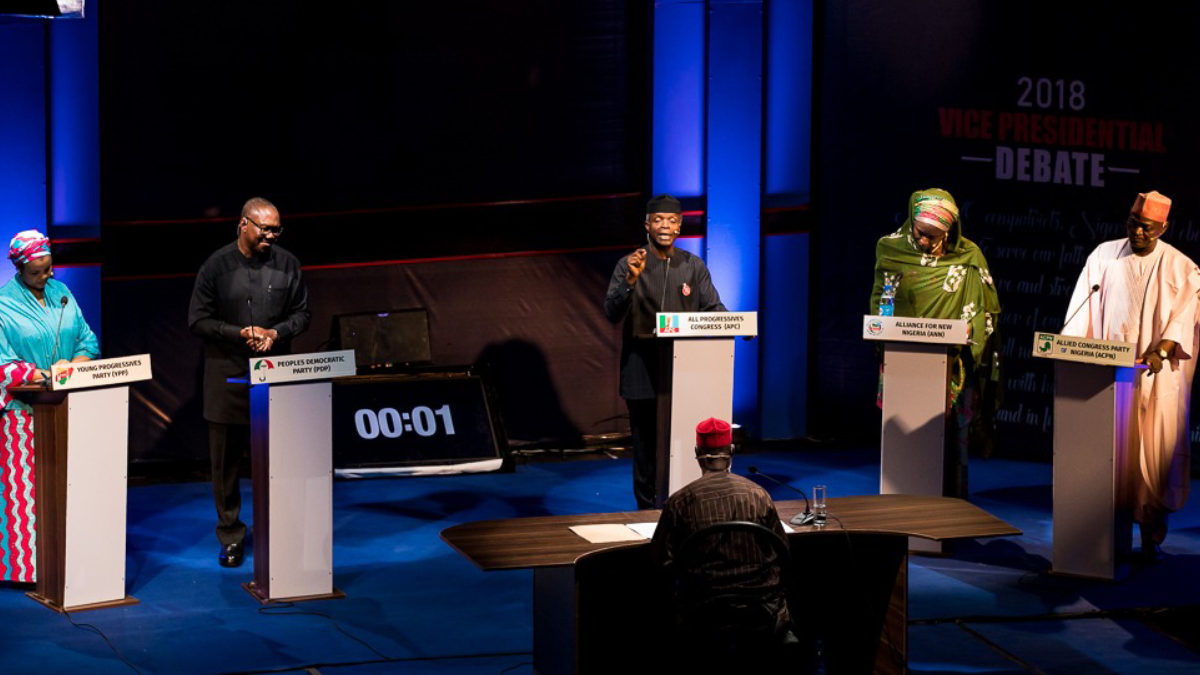
Nigerian politicians are probably the only people in the world who apply for a job and then blatantly refuse to show up for an interview after their potential employer asks them to. For the longest time, this behaviour has bothered Nigerians but there’s a possibility it’ll stop soon.
have it that lawmakers in the House of Representatives are preparing to empower the Independent National Electoral Commission (INEC) to conduct compulsory debates for candidates vying for the posts of President and Governor. This move was made possible by a private member bill sponsored by House of Reps member, Ikeagwuonu Ugochinyere.听
What are the specifics of the bill?
The bill is proposing to change the Electoral Act to add a new section (24) saying that:
- INEC must ensure that a Presidential and Gubernatorial Debate is conducted for people seeking to be elected into the offices of President and Governor on a date it picks.
- Anybody looking to be the President of Nigeria must participate in the Presidential Debates, during which they are required to present a detailed analysis of their manifesto and plans for Nigeria as its potential President.
- Anybody looking to be the Governor of a Nigerian State must participate in the Gubernatorial Debates, during which they must present a detailed analysis of their manifesto and plans for the State as its potential governor.
Timeline of Nigerian Presidents who refused to appear in debates
Refusal of candidates to participate in debates has been a thing in Nigeria for so long that it has become almost normalised. It鈥檚 kind of bizarre too because all the Presidents of Nigeria since its return to democratic rule in 1999 have been .
1999鈥擮basanjo won his election into office even though he refused to debate Olu Falae, his major rival.
2003鈥擮basanjo still won his reelection bid after he turned down a debate against his major opponent, Muhammadu Buhari.
2007鈥擴mar Musa Yar鈥橝dua refused to debate against Muhammadu Buhari and won the election by a landslide.
2011鈥擥oodluck Jonathan won the Presidential election after failing to show up to the debate
2015鈥� Buhari who had attended debates for his past Presidential campaigns, did not attend the 2015 debate and went on to win the election.
2019鈥擝uhari refused to attend the Presidential debate but, after a bit of pressure, participated in a political town hall program known as The Conversation. However, that hardly counts as a debate as the audience was mostly made up of his and Atiku鈥檚 (his main opponent at the time) supporters.
Governorship candidates also do the same thing and go on to win their election bids. In the just concluded Edo State governorship elections, for instance, APC candidate, , yet he went on to win the elections. If this bill becomes law, however, no candidate will refuse to appear in debates again because it will become a requirement rather than an option. Once this becomes a necessity.
Why does this bill matter?
You can draw a straight line from Nigeria鈥檚 poor leadership problem to the refusal of candidates to participate in debates. Political economist and Professor, 听
Speaking to journalists before the 2023 general election, Utomi gave an example of South Korea鈥檚 situation.
鈥淭he fortunes of South Korea were turned around because the electoral commission was so despondent about the quality of their politics that they decided that the thing that should matter the most for elections are debates between candidates,鈥� he said, explaining it was incorporated into conventions in the country鈥檚 politics.
鈥淥nce debates came to define (the) elections, moneybags and all kinds of criminals and charlatans ran away and their electoral process became one of a sustained, enormously developed country,鈥� Utomi continued.
Will this bill be successfully passed?
I鈥檒l hold your hands when I say that the chances of this bill going on to become law aren鈥檛 a 100 per cent, partly because it still has to pass through five more stages, and mostly because the bill has been around before and was not successful.
In July 2014, a similar bill seeking to make Presidential Debates compulsory did not get past the fourth stage (reference to a committee) because the committees. They took the decision because they felt election debates 鈥渟hould remain outside the purview of the law.鈥�
What can you do to help the bill become law?
- Track the bill’s progress as it moves through different stages by monitoring official channels for media updates.
- Talk to other people about it. You know that saying about 鈥減ower in numbers.鈥澨�
- Participate in Public Hearings: The National Assembly usually organises public hearings for bills under consideration, and Citizens are allowed to attend to express their opinions.
- Reach out to your representatives: you can contact the lawmaker representing your constituency via email or phone to let them know you support the bill. Here is the list of all and with contact details attached.
- Launch or sign digital campaigns through platforms like .
- Advocate for the bill on social media platforms by using hashtags.