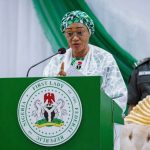
On Sunday, July 13, former Nigerian president Muhammadu Buhari died at age 82 in a London clinic and was in his hometown of Daura, Katsina State, on Tuesday, July 15. The former President had long with ill health before his passing, but according to some , the body that Vice President Kashim Shettima home was a clone, and the 鈥渞eal鈥� Buhari had died as far back as 2017.

If you are confused, rest assured鈥攖hat is the proper reaction. There is a saying in Nigeria: 鈥淚f they explain Nigeria to you and you understand, they did not explain it well.鈥� The sentiment is particularly apt here. Still, we will soldier on to unpack the Buhari-clone saga and see if it makes sense.
It is not every day that a president must declare, 鈥淚t is really me, I assure you,鈥� while denying a sci-fi鈥搒tyle body swap. Yet that is exactly what Buhari at the United Nations (UN) Climate Conference in December 2018, as rumours of his death swirled and gained unexpected traction.
So, how did Nigerians find themselves living the plot of a science-fiction soap opera? It was a perfect storm of factors.
The constant fluctuation of Buhari鈥檚 health
From the moment he assumed the presidency in 2015, Buhari鈥檚 fitness became a national preoccupation. Frequent, lengthy medical trips to London disrupted governance and fuelled endless speculation. A 104-day to London in 2017 was particularly controversial. In total, he spent of his presidency receiving treatment in London.
Prolonged presidential medical absences are prime fuel for rumours and conspiracy theories. Transparent, timely updates could have doused the fire, but the Buhari administration had a different approach.
[newsletter type=-z-daily]Media secrecy
The presidency was frustratingly tight-lipped about Buhari鈥檚 condition, offering as little information as possible. As recently as a matter of days before his passing, the talk around his health was still wrought with from those closest to him. When official sources are silent, wild stories rush in to fill the void鈥攁nd often take on a life of their own.
Nigerians had seen this movie before
Vital context lies in the sense of d茅j脿 vu that Nigerians felt regarding Buhari鈥檚 health. His predecessor, Goodluck Jonathan, had president after Umaru Musa Yar鈥橝dua just short of his third year in office. Yar鈥橝dua鈥檚 tenure was marked by prolonged absences for medical treatment and a similar reluctance to share health updates with the public. When Buhari鈥檚 administration repeated that pattern of secrecy, Nigerians understandably felt they were reliving recent history鈥攁nd the rumours gained an air of plausibility that kept them alive in the national consciousness.
Nnamdi Kanu鈥檚 conspiracies
While it is not unbelievable to claim that a sick president might have died during long absences, the rumour truly took flight when Nnamdi Kanu, leader of the Indigenous People of Biafra (IPOB), that a Sudanese look-alike named Jubril was masquerading as Nigeria鈥檚 president. The claims spread widely on social media, and viral videos of an ailing or supposedly dead 鈥淏uhari鈥� in a London ward, coupled with obsessive ear-comparison analyses, became one of the most surreal chapters of his eventful presidency.
Buhari鈥檚 administration was an聽unpopular one
By 2017, many Nigerians were already disillusioned with the Buhari administration. The government had made little headway against Boko Haram and was already courting conflict with a new adversary in the south-east: IPOB. Anti-corruption efforts were accused of partisanship, targeting only political rivals of the APC-led government, and the economy was faltering. On the international stage, Buhari was being labelled a f
In that climate of frustration, a tale of a dead (and cloned) president offered a dark form of wish fulfilment. Wishful thinking fuelled the rumours and allowed them to gain traction. When Buhari鈥檚 death finally occurred in 2025, the mocking reaction in some quarters revealed just how deeply many had long wished him gone.
Buhari is not alone in inspiring premature death rumours. He is in the company of several of Africa鈥檚 aged leaders. African nations often resemble kids who peak in high school and spend their adulthood trying to relive those early glory days. We keep replaying the classics, whether they were truly hits or not.
Like Buhari, former president Olusegun Obasanjo, a former military head of state, has also been the victim of . He claims he has been falsely reported dead at least seven times since he was democratically elected in 1999.
Recently, in May 2025, a university student in Kenya was for falsely reporting that embattled President William Ruto had died in 2024.
Rwanda鈥檚 Paul Kagame, who has led the country since 2000 and faces , has frequently been the subject of . Uganda鈥檚 Yoweri Museveni, in power since 1986, has also seen
When Cameroon鈥檚 Paul Biya returned from an abroad in 2004, he dispelled rumours about his death with the words: 鈥淧eople are interested in my funeral; I will see them in twenty years.鈥� Two decades later, at age 92, he has ruled for forty-three years and an eighth term in office. about his death prompted his government to reports related to his health.
These reports arise from a sense of collective helplessness. Many Africans feel powerless to remove ageing leaders who cling to power, so they fantasise about their deaths鈥攖he only apparent escape. Often, these fantasies manifest as premature rumours. When these leaders finally die, it is not surprising that the frustrated youth they governed may feel compelled to dance on their graves.
Nnamdi Kanu may have started the outlandish Buhari-clone rumour as a propaganda tool for his sectarian struggle, but it endured thanks to a regrettable combination of factors. Buhari鈥檚 prolonged medical trips to London, the presidency鈥檚 tight-lipped approach to his health, and the haunting echo of Yar鈥橝dua鈥檚 own secrecy and eventual death all conspired to give the rumours life. Ultimately, the frustrations of a citizenry fed up with harsh policies truly gave those rumours wings to fly.
[ad]