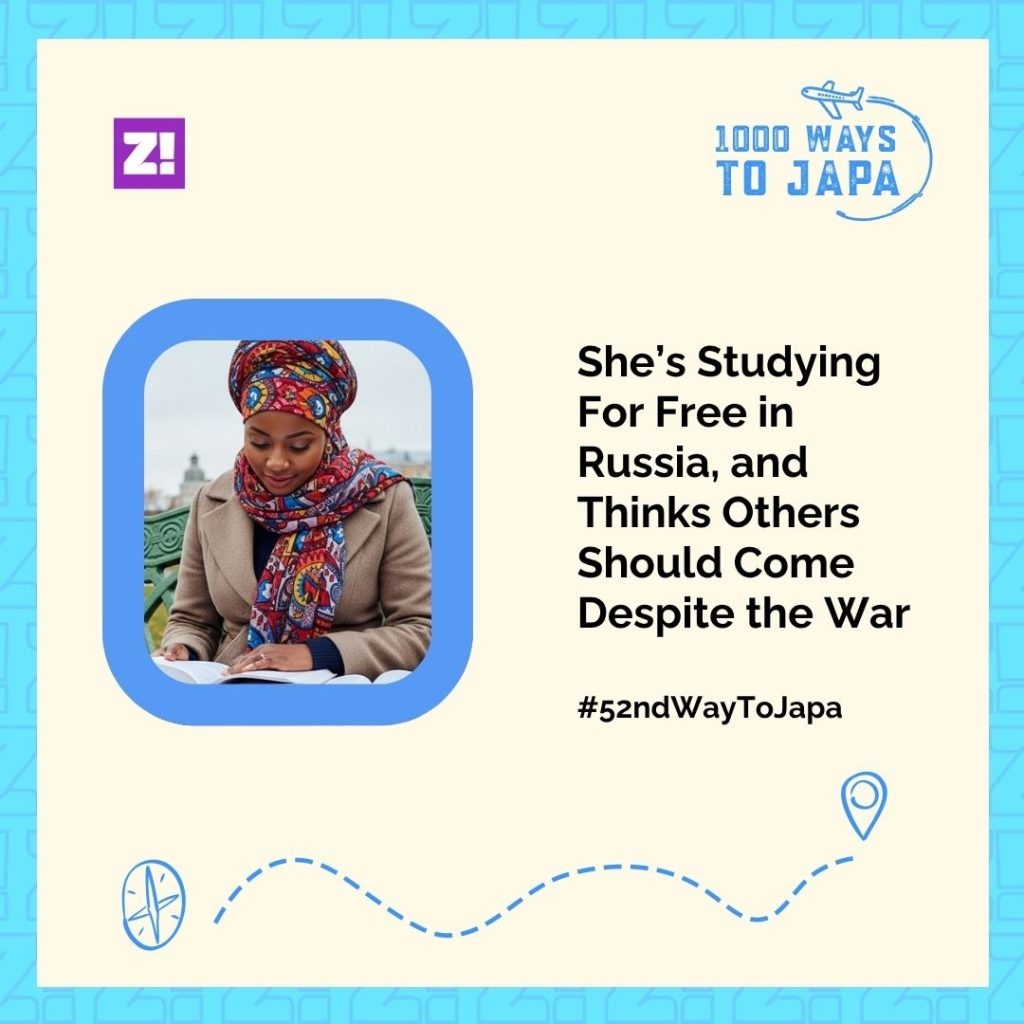
Dola* (25) decided that Nigeria was no longer an option for her after completing her undergraduate degree. So she applied for a Russian scholarship, packed her bags and left before her parents could say no. Here, she shares why she still encourages Nigerians to apply for the scholarship despite the war.聽
Where do you currently live, and when did you leave Nigeria?
I鈥檓 currently in Moscow. I left Nigeria in September 2022.
So how exactly did you leave?
I had my bachelor鈥檚 degree in Nigeria. COVID happened after I graduated. It gave me time to reflect, and I decided that I wasn鈥檛 going to do my master鈥檚 in Nigeria. Before then, my friends and I were always searching for scholarships.
I remember applying for the Chevening scholarship twice, the Erasmus scholarship, and a few others. I did my National Youth Service Corps (NYSC) in Imo State, and one of my friends told me about a friend who got a Russian scholarship called Open Doors. He said we should try it, and I agreed.
At the time, there was no talk of war or anything like that, so we just applied. I think we applied in December 2020, and that was how it started.
Was it a fully funded scholarship?
The Open Doors scholarship is a scholarship of the Russian government that covers tuition and a monthly stipend. Every other thing, including your travel and personal expenses, is on you.
It鈥檚 open to applicants from most countries, as long as your country鈥檚 government has a good relationship with Russia.
Is the scholarship still available now?
Yes, it鈥檚 still running. In fact, the current application window closes in about five days.
Oh, interesting. Can you share more about the process? How did you apply, and how can others do the same?
Sure. When I applied, the process opened in October and closed in December. It has about three or four phases, depending on your study level. Since I came in for my master鈥檚, I went through just two phases.
The first stage runs from October to December. At that time, the process was different from now. Back then, you just submitted your portfolio to sell yourself to the selection team. You鈥檇 upload your CV, certificates, and any other documents you had.
Then, they would shortlist candidates for the second stage. That stage involves writing an exam and doing an interview. The exam itself is in two parts: one supervised live (similar to a proctored session) and another done remotely while the candidates鈥� screen activity is monitored.
After that, they release a list of successful candidates on their website. If your name is there, that鈥檚 when your chosen university starts reaching out to you.
During the application, you can select up to six universities in order of preference. Usually, the first school that contacts you is the one that admits you.
In my case, I wanted to study in Moscow, but my background wasn鈥檛 considered directly related to the master鈥檚 program I applied for.
I had to think fast because there was a short window to make changes. It was like the NYSC situation, where everyone wants Lagos or Abuja, but you end up choosing another location because time is running out. So, I picked the last university on my list.
I reached out to them via email, and the response time amazed me. Unlike in Nigeria, they replied almost immediately. They told me what to send, and I did.
After that, the school asked for additional documents like proof of degree (BSc), medical reports showing I鈥檓 free from HIV, tuberculosis, and hepatitis, and my international passport. All documents must be translated into Russian because that鈥檚 the official language here.
After this, you鈥檒l be given a two-week deadline to return everything. The entire process typically takes about a year. For example, if you apply in September, you鈥檒l resume by the following September.
When I applied three years ago, the process was smoother, but lately, it has become more competitive, similar to the Erasmus process. Some people who got the scholarship last year still haven鈥檛 resumed.
Would you still recommend that people apply?
That鈥檚 tricky. When I came, the flight fare was around 鈧�280,000. Now, it鈥檚 about 鈧�1.5 million, and that鈥檚 if you buy early. I wouldn鈥檛 ask people not to come, but I鈥檇 advise people to plan carefully before coming.
Before I left, I worked at a bank for about nine months. Looking back, I wish I had worked longer or deferred my admission by a year to save more. Because coming here can be mentally, financially, and emotionally exhausting.
Truth is, about 90% of Nigerians here don鈥檛 plan to stay permanently. Most of us just use it as a stepping stone to move somewhere else. The downside is that the Russian currency isn鈥檛 strong. Unlike Canada or the UK where you can work a few days and send money home, here you have to work multiple shifts just to make ends meet.
Also, because of the war and sanctions, most Western embassies have closed, so you can鈥檛 easily move from here to another country. People now go back to Nigeria to reapply for visas. But I鈥檓 trying to bring my siblings here.
Would you say life in Russia is better than in Nigeria?
Honestly, yes. When I left Nigeria, things weren鈥檛 even that bad yet. I just felt stuck and depressed. Work in Lagos was draining, and I needed a change.
When I came to Russia, it wasn鈥檛 easy. The war had just started that January, and people were panicking. I even stopped telling people I was in Russia because anytime I said it, they鈥檇 start scaring me and asking if the military had bombed my area.
I didn鈥檛 even tell my dad I was moving to Russia until I was about to travel to Abuja for my visa. I just called to say, 鈥淒addy, I鈥檓 going.鈥� I didn鈥檛 ask for permission. I鈥檝e always been strong-willed like that.
People at work asked, 鈥淲hy Russia?鈥� and I didn鈥檛 even bother explaining.
Despite everything, Russia is still strong. They continue to fund education for international students from master鈥檚 to PhD, and have even added bachelor鈥檚 programs recently.
I was schooled in Siberia, which is one of the coldest places in the world, but I have no regrets.
So what was it like adjusting to life in Russia, especially living in such a cold place?
Honestly, the first few weeks were tough. Before coming, I bought jackets at Yaba market, but those ones can鈥檛 stand the Russian cold. They鈥檙e only good for mild weather like autumn.
When I arrived, I had to start from scratch, new clothes, shoes, coats, everything. I even came with a bad phone. There were no jobs for the first few months, and I came during winter, which made it worse.
Winter here is brutal. It gets dark by 4 p.m., sometimes 3 p.m. And since I didn鈥檛 speak Russian then, it felt like being on another planet. You can鈥檛 even ask for help properly because of the language barrier.
When I arrived, I didn鈥檛 have any real friends here, just 鈥渁 friend of a friend of a friend.鈥� That lack of community made things harder.
On a scale of one to ten, how happy are you in Russia?
I鈥檇 say seven. Russia has given me so many opportunities.