

Written by Matilda Inioluwanimi Adegbola
In 1983, a Nigerian woman won a senatorial election and quietly made history as the first female Black senator, not just in Nigeria, but the entire world. Her name was Franca Afegbua. Being a beautician, no one had believed she stood a chance. What they hadn’t counted on was that beauty was only a platform for her.
Born in Okpella, in Estako-East local government area of Bendel state 鈥� current day Edo and Delta states 鈥� her family migrated to Northern Nigeria. Growing up across Kano, Kaduna and Gusau in Sokoto, she noticed urban areas had modern amenities her native community did not: piped-borne water and paved roads. Her desire to see her native community become better developed would ultimately influence her decision to get involved in politics.
But, her political journey wasn鈥檛 linear; it began with the business of beauty.
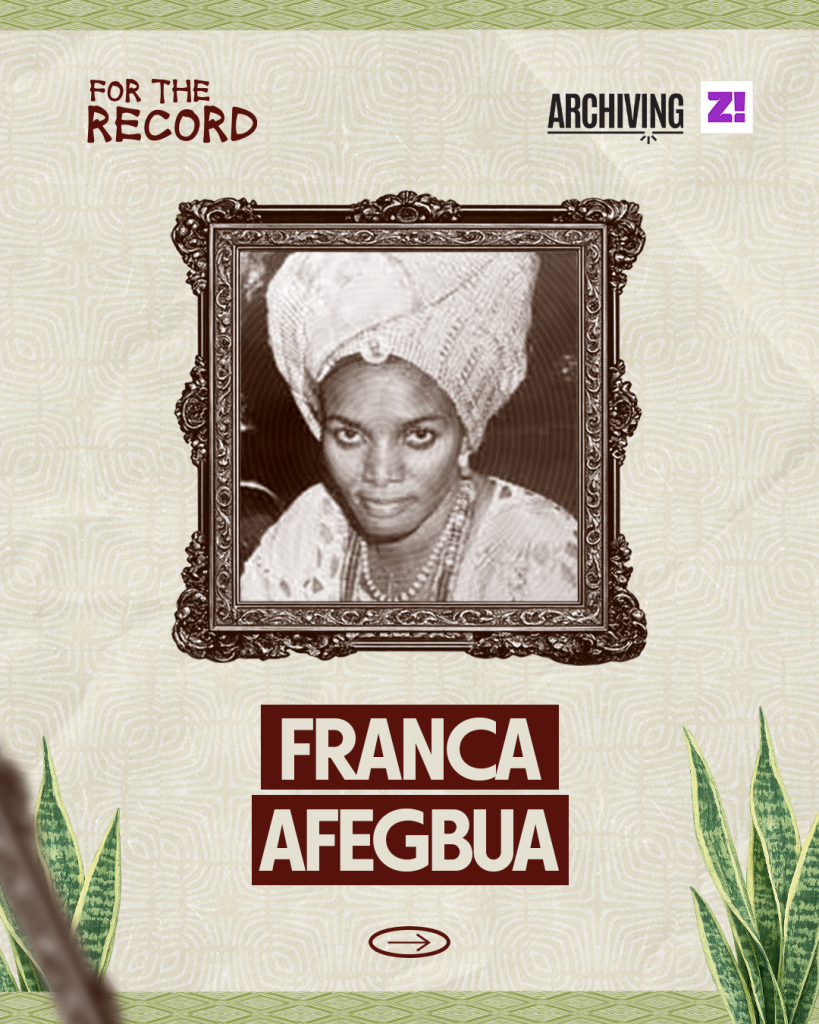
As a child, she participated in several local beauty pageants, winning the Miss Kaduna beauty contest. Following her education at Our Lady High School, Kano and St. Louis Convent, Kaduna, she became an English Continuity announcer at the Northern Nigerian Broadcasting Service. She went on to work as a sales/display girl for UAC, Kaduna, where she joined the junior staff trade union, her first experience with organised collective action.
Through the union, she gained a scholarship to study in Sophia, Bulgaria, and graduated with a degree in political science with a diploma in industrial relations.
When she returned home, she faced backlash for studying in a socialist country. Undeterred, she went on to train in hotel management and took over the management of the Federal Palace Hotel. While there, she was offered a position at Texaco Overseas Petroleum, eventually becoming a consultant to Ashland Oil, Superior Oil, and NISSCO. This gave her the financial foundation to do what she had always wanted: build something of her own.
She launched a hairdressing business with salon branches and beauty schools spread across Kano, Kaduna, and Lagos, including a salon and spa at the Falomo Shopping Complex in Ikoyi. The business would prove to be her bridge for venturing into politics.
In 1978, she earned international acclaim at the Salon 鈥�78 hairdressing convention, a forum for hairdressers and beauticians, which featured participants from Denmark, Japan, the USA, Germany and Switzerland. Franca鈥檚 hairweaving demonstration was described as an art, and her incredibly fast pace mesmerized the audience, including the deputy high commissioner for Nigeria in Great Britain, Mahmood Yahaya, who commented: 鈥淔ranca has been able to achieve what FESTAC couldn鈥檛 in Britain.鈥�
Franca鈥檚 win was significant as this period saw women鈥檚 fashion move from centering wigs to styles using their own hair. This shift led to an increase in salons offering relaxer treatments and promoting a polished, 鈥減ut-together鈥� aesthetic that Franca herself came to represent.
Running a high-end beauty salon chain in the elite part of Lagos allowed Franca to form close relationships with significant members of the political class, among whom was Joseph Sarwuan Tarka, Senator for Benue East in 1979 and the Chairman of the Senate Committee on Finance and Appropriation. Through Tarka鈥檚 political party, the National Party of Nigeria (NPN), Franca contested for a senatorial seat in Bendel State in 1983.
Her opponent, John Omolu’s popularity, combined with her career as a beautician, led many to believe Franca didn’t stand a chance. What they missed and underestimated was that the salon had given her something more valuable than any party machinery: she knew women. She had washed their hair, listened to their stories, and earned their trust across three states and two decades of work. Where her opponents spoke about women, Franca spoke to them.
By mobilizing women as her base and securing their support, Franca won.
Despite her term being cut short three months into office by a military coup, Franca鈥檚 place in history was already secured. Franca Afegbua was the first democratically elected Black female senator in the world.
Years later, in an interview with P.M. News, she reflected on what it had cost her and what it meant:
鈥淧eople think office holding is rosy, but I want to tell you that in holding public office, there is a lot of ugliness. If you sincerely and honestly go into politics because you want to help the masses, you should not make it a do-or-die affair.鈥�

