In many families and societies, there are unspoken rules about who you should be and how you should live. They are usually passed down as expectations that feel impossible to challenge, and over time, these rules can shape the lives of generations in a not-so-good way. Unfortunately, many of them have had to hide who they are because of these iron-clad expectations and rules.
But every so often, someone decides that they don’t want to be in the shadows that hundreds of people in their generation have retreated into. They are more concerned with choosing honesty and happiness over the “What would people say?â€
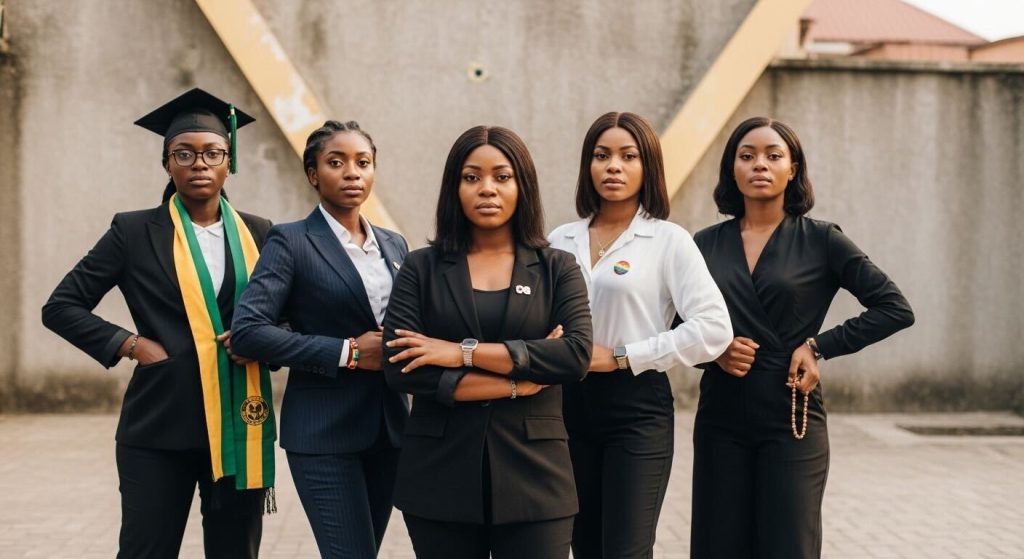
In this article, five Nigerians reflect on being the first in their families to make unconventional choices and how those decisions shaped their sense of self.
1. “I Do Not Hide The Fact That I’m a Woman Who Loves Women†— Mari*, 26
I know that there are some people in my family who have a complicated relationship with their sexualities and shouldn’t be in a heterosexual marriage because they definitely don’t lean that way. Unfortunately, due to societal expectations and hetereonormative nonsense, they never dared to acknowledge that part of themselves. They’ve had to hide and just accept that, maybe in their next lives, they’ll get to be open about who they are.
I, however, have refused to do that. I do not hide the fact that I am a woman who loves women. There were some years when I was scared to tell people because I was worried about how they would react, but now I don’t actually care. If you ask me, I would tell you, and how you respond to that is none of my business.
I’ve realised that to be happy, you need to be okay with not caring what other people think of you. People will talk, and they’ve definitely had a lot of opinions about the way I’ve chosen to live my life, but unlike those relatives of mine who have resigned themselves to a loveless marriage for the rest of their lives, I don’t have to hide. I am very fulfilled and proud of who I am.
2. “I Don’t Care About What Society Says I Should or Shouldn’t Do†— Arike*, 46
My mum, her mum, and the other women who came before them never believed in the concept of getting a divorce. If your husband cheats, they’ll tell you it’s a man’s nature to cheat, and you’ll just have to accept that. If he treats you like you’re dirt under his shoes, they’ll tell you to keep coping because of your children. When my ex-husband was all shades of mean to me in all the years we were married, and I flirted with the idea of getting a divorce, my mum told me not to try “that rubbishâ€, and so, I stayed with a man who detested me for over two decades.Â
For years, because of my mum, I decided that it would be better to be in a loveless marriage than be a divorcee but then I had a lengthy and emotionally taxing conversation with a friend who had divorced her husband, and she made me see that I would only be hurting myself and my kids more if I stayed with a man who barely showed an ounce of kindness to the people he called family.
That conversation gave me the courage I needed to finally leave the marriage, and while my mum has not been accepting of that, I don’t care. For the first time in years, I’ve gotten my spark back. I don’t have to be in my car on my way home from work, worrying about the next feature about myself that the man-child I called an ex-husband would nitpick.
A lot of women in my family have side-eyed me over my decision to be a single mother, and my mum has told me some of the interesting comments she’s heard from them about me, but I really don’t have the strength to think about that. I simply don’t care about what society says I should or shouldn’t do. I am at the peak of happiness, and that’s all that matters.
3. “I Like to Prove a Point. It’s What I Do.†— Chiamaka*, 23
While many people on both sides of my family are educated to some level, none of them graduated with a first-class, and from the moment I was admitted to university, I kept that information at the back of my mind. I like to prove a point. It’s what I do. If I realise I have the potential to be the first person to achieve something, I would immediately lock in so I can have eternal bragging rights.
So, when I found out that no one on either side of the family had graduated with a first-class degree? I decided that I would be the first person, and not just for bragging rights. I thought it would be a well-deserved slap in the face of my father’s family. They were very comfortable disrespecting my mother just because they could, and every time I thought of giving up at school, I would think of how they would react to the news of me, the daughter of the woman they don’t like very much, getting a first-class, and I would immediately go back to studying.
When I realised that I was graduating with a first-class, I was the happiest girl ever. I thought about how proud my mother would be when I told her, and I burst into tears. It was when I got the degree that I realised how much it would mean to my mother to have a daughter who would be the first on both sides of the family to graduate with a first-class degree. It’s a really great honour, and I’m glad I got to achieve it.
You’ll Love: I Got Harassed and My Friend Refused to Let Me Stay Quiet
4. “I’m Trying My Best Not to Turn Out Like the People Before Meâ€â€” Alex*, 22
I’ve realised that a lot of people in my family didn’t get to be who they were, not necessarily because they didn’t want to, but because of the chokehold society had on them; they’ve had to retreat into the shadows. I do not want to retreat into the shadows.
I’m the first in my bloodline to study what I wanted (psychology), truly because I wanted to, and not because it would bring me a lot of money later in the future. I’m the first in my bloodline to confidently come out as nonbinary to their parents, even though they are not okay with it. I’m the first in my bloodline to date someone who society would never welcome into their fold. I’m the first in my bloodline to go after positions they wanted, like being the Editor-in-Chief of my school’s publication. I’m the first in my bloodline who realised that they didn’t want to keep passing on trauma to the next generation, and I took myself to get diagnosed.
All of these might not seem like a big deal to other people, but I know I’m trying my best not to turn out like the people before me. I want to exist as I am, and I want to go for things without thinking ‘What if?’ and resigning myself to a lifetime of regrets. That won’t do at all.
5. “To Be Free, You Have to Release Yourself From Certain Shackles†— Fatima*, 24
Religion is a very important aspect of both sides of my family. Islamic, christian, and traditional practices were all allowed. My parents are muslims, but I’ve attended church sessions with my cousins and gone to Osun festivals with my grandparents. Religion was all around me, and so it made sense that there was a period in my life when I regurgitated religious teachings because I thought they were the proper teachings, but then I fully became aware of the fact that I’m a woman.
Religion is not very kind to women. It’s something that I’ve had to make my peace with. The men get so many free passes, but it’s like religion was built to torture women. That’s what it looks like. Understandably, men have twisted religion to benefit them, but at the same time, I couldn’t always shake off the fact that even the religion itself hardly benefits women, and that’s why I decided to leave it. That was the best decision I’ve ever made.
To be free, you have to release yourself from certain shackles, and for me, religion was that shackle. My political views and beliefs do not align with the religion, so what’s the point of practising something that does not wish me the best?
Next Read: What She Said: I Left a Safe Marriage with a Man for a Woman Living a Double Life
91´óÉń’s HERtitude is back this April 2026 and it promises to be bigger and better! Grab your tickets here: and don’t miss out on all the fun!!