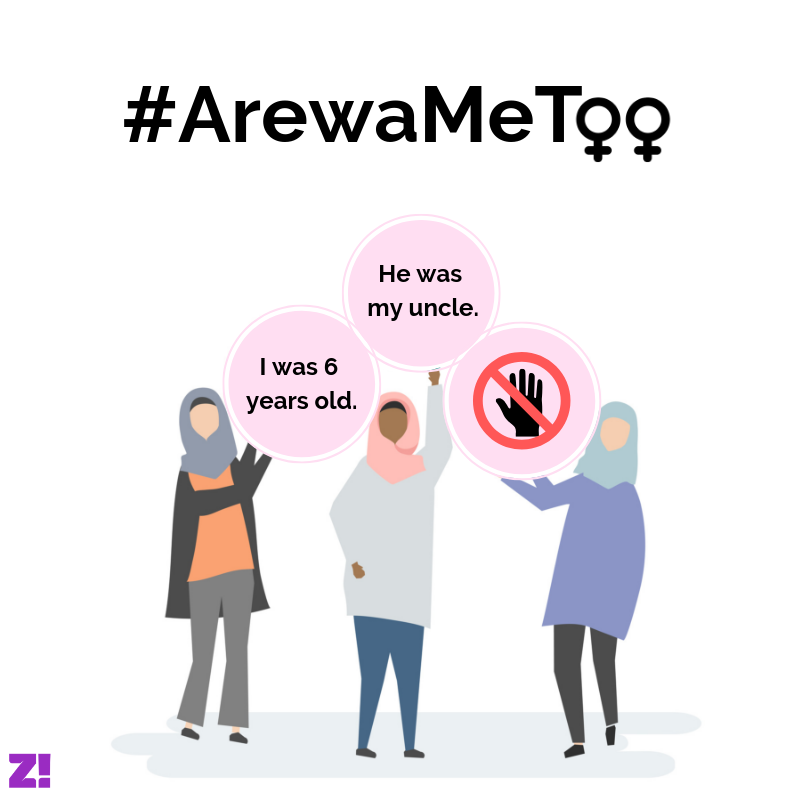
Ten Things We Learned From The #ArewaMeToo Movement.
Following the trend of the notorious #metoo movement, women from Northern Nigeria shared stories of sexual assault and abuse, calling out their abusers across social media with the tag ā€“ #arewametoo. The stories shared were heartbreaking. The reactions that followed ranged from sympathy to rage to victim shaming. In all of it, these are the ten most important things we learned from the #ArewaMeTooMovement. Nigerian women, especially abuse victims are tired of being silenced and tired of people trying to silence them. Enough is enough. The abusers are more often than not close to home. They are also most likely…
Following the trend of the notorious #metoo movement, women from Northern Nigeria shared stories of sexual assault and abuse, calling out their abusers across social media with the tag ā€“ #arewametoo. The stories shared were heartbreaking. The reactions that followed ranged from sympathy to rage to victim shaming. In all of it, these are the ten most important things we learned from the #ArewaMeTooMovement.
Nigerian women, especially abuse victims are tired of being silenced and tired of people trying to silence them.
A friendly reminder that sexual abuse, sexual harassment and domestic violence arenā€™t issues you can ā€œunlookā€ or ā€œmind your businessā€. It is all our problem. SILENCE IS COMPLICIT!
— T (@TauhidaBabaGana)
Enough is enough.
The abusers are more often than not close to home.
First friend- my uncle used to touch me in inappropriate places
2nd friend- me too, it was our Mallam
3rd friend- me too, but it was the gateman
4th friend*in a whisper- my boyfriend
— Hassana Maina (@hassana_maina)
They are also most likely to be serial abusers.
No matter how many victims come out with their stories, there’ll always be people like this.
I will be on this twitter and I guess I have to register this….
What is happening on twitter today under the hashtag is ungodly. To be best of my knowledge, it is against everything Islam stands for. is promoting shamelessness.
— Big Daddy (@BigDaddyTalkss)
But people like him couldnā€™t silence the brave women who shared their stories.
Our culture of silence is very dangerous.
is here to stay. Don't succumb to cultural and religious manipulations – they are forms of abuse. , , , .
— Jaliyyah Bello (@JaliyyahBello)
People who silence victims are just as bad as the abusers.
Children make up a large percentage of the victims.
Note : All these came from first-hand testimonies by his victims, who are mostly underage girls. They were compiled painstakingly over months.
Surrounding circumstances have left us with no option but to conceal the identities of these victims.
— FeistyQueen (@Ice131Queen)
One in four girls by the time she reaches 18 would have experienced at least one form of sexual assault.
While girls make up a larger percentage, young boys are often preyed upon too.
While weā€™re at it, Almajiri boys go through an unspeakable level of abuse from their malams. Physical, sexual & psychological. Itā€™s so gut wrenching to even think of and we need to take this fight to the streets. Boys & men are also victims of abuse/rape
— Zainab (@Binanii)
And itā€™s sometimes harder for them to speak out.
It’s bigger than sexual assault in Northern Nigeria.
This is NOT just about Arewa. It is a metaphor for the entire nation.
A salute to the brave ones. To the victims who are now choosing to be survivors & THRIVE!
Thanks for
— Whole Women Network Co-op (@wwncoop)
Sexual assault is an epidemic thatā€™s spread across the whole country.
For every victim who shares their story, there are hundreds more who can’t.
Find the time to read some haunting tales of sexual abuse via the hashtag . These victims are just a fraction of the many prevented from sharing their stories in a society quick to question the morality of the abused, while protecting their predators.
— Gimba Kakanda (@gimbakakanda)
But every victim who shares their story lends a voice to those who canā€™t.
It’s never the victim’s fault.
It's not your fault and you shouldn't be ashamed of what happened. Stay strong.
— KhadeejahšŸ (@SoulUntamed_)
What she was wearing, where she was, what time of the day it was, all these things donā€™t matter.
It’s more than a hashtag. It’s a safe space for victims to share their pain.