
MTN recently hiked their data bundles by 50%, and Nigerians are feeling the pinch. While users struggle with higher bills,, and
We spoke to a financial expert and everyday MTN users to break down what this really means.
What鈥檚 going on here?
On February 11, 2025, MTN Nigeria made its internet services more expensive. The Nigerian Communications Commission (NCC) approved this 50% hike for
But today, we鈥檙e focusing on MTN鈥檚 data price increases and how they impact users, investors, and the company鈥檚 overall revenue.
What does it mean for you?
Remember whenof MTN data and lasted most of the week? Well, those days are over. MTN has asked its users to either double their internet budget or cut their mobile usage in half. The that this move is necessary due to “rising operational costs” and “infrastructure maintenance”鈥� corporate speak for “Telecoms need more money.”
MTN Nigeria鈥檚 CEO, Karl Toriola, has also justified the price hikes, to keep up with the naira鈥檚 devaluation and the country鈥檚 escalating inflation.
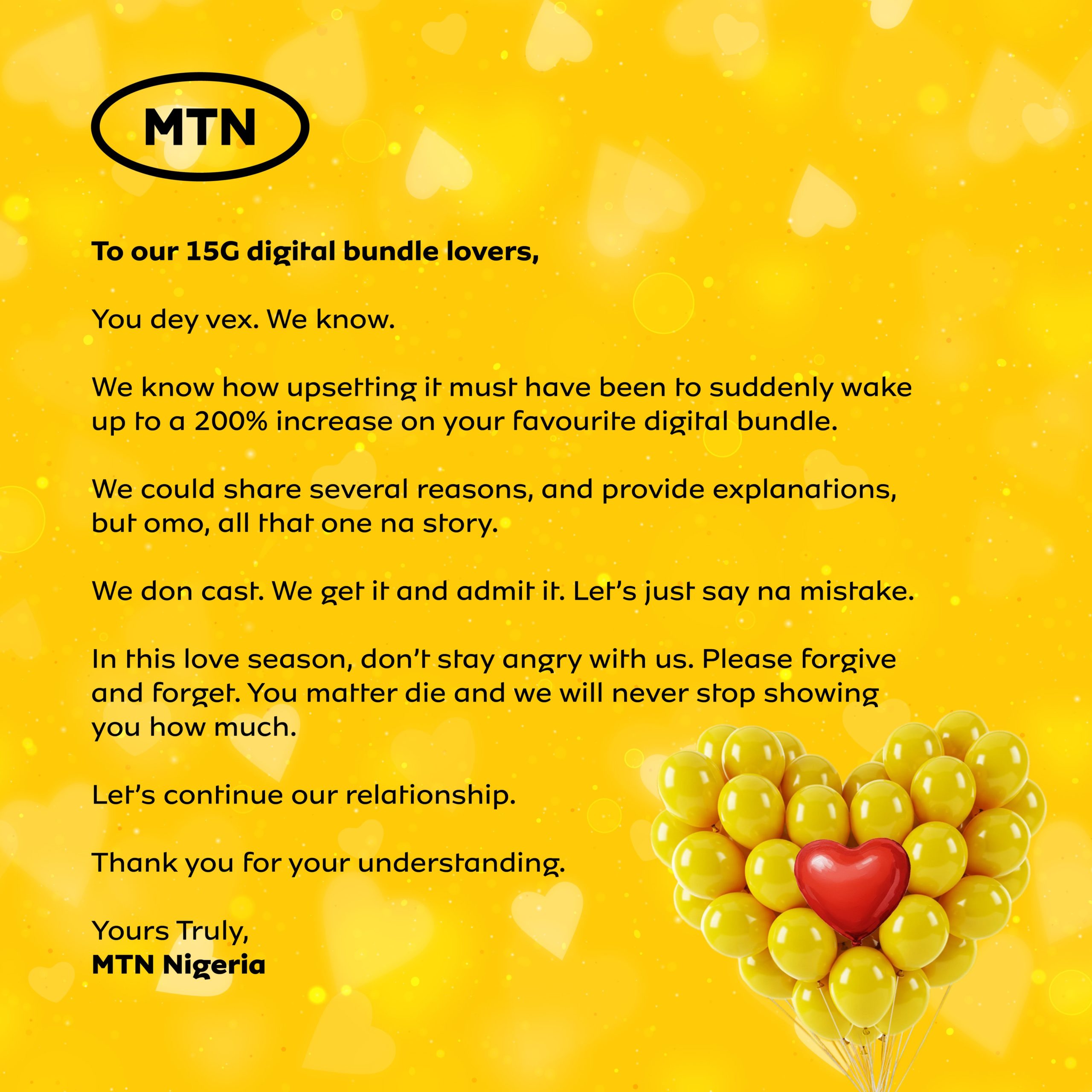
As if the 50% tariff increase hadn鈥檛 already stirred up enough controversy, . This hike sparked outrage among customers. On February 13, the protested the hike, demanding an immediate reversal to avoid severe consequences.
According to the Union, 鈥淚f the telecommunications companies fail to revert to the old tariff by the end of February 2025, a total shutdown of their operations nationwide will commence from March 1, 2025.鈥�
How much more are you paying?
but the 50% approved by the NCC still stands.
This means you鈥檙e paying:
- 鈧�1,500 for a (previously 鈧�)
- 鈧�750 for a 2 GB daily plan (previously 鈧�500)
- 鈧�900 for a 2.5 GB daily plan (previously 鈧�600)
- 鈧�3000 for a 7 GB weekly plan (previously 鈧�1,500 for 6 GB)
- For heavy data users: for a 1.5TB plan (previously )
- 鈧�120,000 for a (previously 鈧�)
NCC says this is necessary to keep telecoms service running smoothly in Nigeria, but at what cost?
Why should you care?
Unless you’re using smoke signals to communicate or prefer to go outside and touch grass, this affects you.
Let’s break down who’s winning and taking the L in this situation.
For your wallet: That monthly data budget? Multiply it by two
If you do anything online: run a business, work remotely, take online classes or even doom-scroll on social media, your wallet will likely feel this pinch.
For most users, this means either spending more money or spending less time on the internet:
Tolani, 22 (MTN User): 鈥淎ll we do in Nigeria is complain, but we always adjust to new situations in time. I normally subscribe to the 25 GB plan with 鈧�6,500. Also, I don鈥檛 like seeing my data run below 20 GB, so once it gets there, I top it up.
Although the plan is now 鈧�7,500, I still pay for it. But it鈥檚 frustrating because it doesn鈥檛 seem to last anymore.鈥�
Sharon, 22 (MTN User): “I used to get 15GB for 鈧�2,000, so this price increase feels frustrating and insensitive. We need to boycott MTN.
I just paid 鈧�3,000 for the same plan, and it鈥檚 irritating. I’ve been searching for online data vendors with cheaper options. I considered switching networks, but MTN is my primary line, and I need it for easier access.鈥�

For Markets: MTN brought happiness this week
MTN investors and shareholders are currently having their 鈥淭o the moon” moment.
The Nigerian stock market has been on a and MTN Nigeria is on this train, too.
But first, what does this mean?
Stocks:

Shares:

Now, let鈥檚 break down what this means for investors:
This tariff increase directly influences MTN Nigeria鈥檚 stock price by shaping revenue expectations, boosting investor confidence, and impacting overall profitability.
Here鈥檚 exactly how:
1. Higher tariffs = more revenue
When MTN increases prices for data and voice plans, it generates more revenue鈥攑rovided customers continue buying. Investors see this as a growth signal, driving up demand for MTN shares and, in turn, increasing the stock price.
2. Investor confidence in profitability
A 50% increase in some data plans means MTN expects to make more money per user, improving its profit margins鈥攁nd investors love growth.
The numbers do the real talking:
In October 2024, the stock traded at around 鈧�175 after a sharp decline due to economic challenges. However, by December, it began to recover, reaching approximately 鈧�200 by year-end.
By January 10, 2025, MTN鈥檚 stock had climbing to around 鈧�250 by month-end.
Following the tariff increase, MTN’s stock has recorded from January to date, closing at 鈧�264 on the Nigerian Exchange (NGX).
If you invested heavily in last year, you鈥檙e likely celebrating with other shareholders right now.

Despite the market’s unpredictability, finance professional projects that 鈥淢TN shares will likely reach 鈧�300 or 鈧�350, depending on the company鈥檚 performance before the end of 2025, and the assumption that FX remains stable at current levels.鈥�
For *Kalejaiye, who bought 鈧�13 million worth of MTN shares (78,799 units) at 鈧�171 per share in October 2024, his investment has grown to 鈧�20.8 million鈥攁 54% return.
He said, “Even though it seemed like bad timing鈥擬TN had just reported a 鈥擨 still bought their shares at 鈧�171 with a plan to hold for 6-8 months. I had hoped the NCC would approve new telecom tariffs within that period and projected a 40% increase, and luckily, news of the tariff hike broke before December.鈥�
The Bigger Picture: Why MTN is really doing this
The justifies the reason for this 50% tariff increase, stating:
鈥淭ariff rates have remained static since 2013, despite the increasing costs of operation faced by telecom operators. The approved adjustment is aimed at addressing the significant gap between operational costs and current tariffs while ensuring that the delivery of services to consumers is not compromised.鈥�
While this increase has boosted MTN鈥檚 stock market value, there’s more to consider:
As Lawal puts it: 鈥淢any of the companies who suffered major foreign exchange (FX) losses, including MTN, in 2023 and 2024, when the naira began to lose value, have significantly repriced their products to reflect the full impacts of the FX loss.鈥�
, FX loss means:

In the first nine months of 2024, MTN recorded a net , leading to negative shareholders’ funds.
Despite this, MTN generated a solid during the same period.
鈥淲hen you look closely at it, this 50% tariff increase offset the impact of FX losses in the industry,鈥� Lawal says.
鈥淚n 2025, MTN will recover its FX losses, and its share price is expected to appreciate significantly,鈥� he says. 鈥淲ith a 50% increase in revenue from data services, it’s clear that MTN investors are set to lock in substantial profits this year.鈥�
鈥淲e鈥檙e already seeing the signs.鈥�

project that MTN鈥檚 voice and data revenues could grow by 40-50%, potentially pushing their total revenue to around 鈧�4 trillion in 2025.
For those complaining about declining call quality or data running out faster, you may be experiencing what’s known as :
Lawal explains: “When a product originally sells for 鈧�2, but due to cost pressure and FX losses, the price rises to 鈧�4 and then to 鈧�6. At some point, further price hikes drive customers away, so companies shrink the product size instead of increasing the price again. Many products you know have gone through this journey.鈥�
The Key Takeaway
This price increase tells three critical stories. For MTN, it’s about balancing their business needs with customer satisfaction. For customers, it’s about adapting to higher costs in T-pain鈥檚 economy. Investors, on the other hand, continue to lock in profits.
What happens next depends on how well MTN delivers better services and how customers adapt to the price changes in a market where switching networks isn鈥檛 always the solution. Nigerians may have no choice but to pay more or use less.