Nigerian culture has a rulebook for adulthood, and seriousness is chapter one. By 27, you鈥檙e supposed to have traded the club, parties and raves for bedrotting or church contributions, family WhatsApp groups and conversations about landed property. Anyone still out at 2 a.m. gets read as carefree, behind schedule鈥攁s if joy has a shelf life.
Age only becomes a problem or shame when it鈥檚 a woman tearing legwork on the dance floor, or a man without a wedding ring, or anyone whose fun doesn鈥檛 come with a sign of responsibility attached.
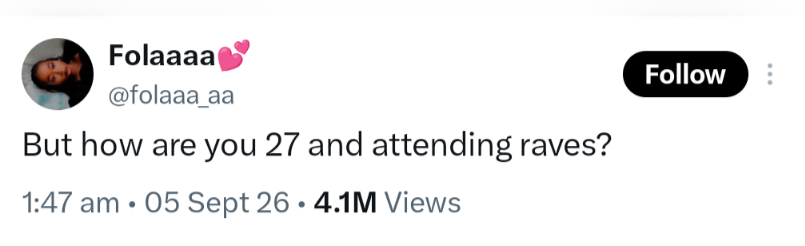
Over the weekend, an X user why anyone past age 27 is raving. The timeline was split: some people pushed back, fighting back an ageism shot. The rest, mostly the Gen Alpha and the last wave of the Gen-Z stream, nodded along like it was gospel. But it鈥檚 a statement that forsakes facts. It鈥檚 a young person鈥檚 ageism and anxiety dressed up as a joke or troll tweet, drawing its confidence from group agreement.
The tweet treats raving like an inherited tradition, something with a generational clock you either fit or age out of, the way you might age out of Owambe as an elderly person. But it isn鈥檛 like that. What Nigerians currently call 鈥渢he rave scene鈥� 鈥� the warehouse parties, beach lineups, and the whole electronic-music culture stacked on top of Afropop, Amapiano, Gqom and House music 鈥� is barely a decade old.
Trace it back to 2019, when Ebi Atte (AKA. Love), fresh back from studying in the UK and unable to find anywhere in Lagos playing the music he wanted, started a private gathering called Sweat It Out. It stayed small until 2020, when two things collided: a pandemic that pushed private parties out into bigger spaces, and the #EndSARS protests, which gave the young generation an appetite for rooms that felt like freedom 鈥� something far from surveillance.
From there, it multiplied fast. 脠k贸lectro, Group Therapy, Monochroma, Element House, Activity Music Festival 鈥� each one younger than the one before it. People who have watched the scene grow describe going from a single party a month a few years ago to a full weekend menu now: a beach edition, a warehouse edition, an interstate edition, back-to-back.
Which means the people this tweet wants to shame for still raving at 27 aren鈥檛 stragglers overstaying somebody else鈥檚 youth culture. In a lot of cases, they鈥檙e the ones who built it.
Also, look past the ratio and the quote-tweets, and the claim falls apart on contact with the people who run the scene.
Start with the DJ booth. Many of the loudest, most consistent names in the Nigerian rave scene over the last four years are not twenty-something. Sunrise (Munachi Abii) is 38 years old. Ifeme C.S. and Bigfootinyourface are in their 30s. Monochroma was co-founded by a software engineer who now DJs under the name Blak Dave. 脠k贸lectro鈥檚 crew includes someone who spends three months a year planning a festival around a day job. Sweat It Out has an investment banker on its founding team. None of these are undergraduates killing time before real life starts. They鈥檙e working professionals who built a scene out of group chats and rented warehouses, on top of full-time careers, in under six years. When the architecture itself is this new, there鈥檚 no 鈥渢oo old鈥� to measure against, because nobody has had the culture long enough to outgrow it.
READ NEXT: How Nigerian Music Walked Into Football鈥檚 Biggest Stage
Importantly, what raves deliver, week after week, is the reason the age argument never had legs in the first place. They churn out mixes that turn strobe lights into kaleidoscopic visions, drops that raise hands like hallelujah, and industrial-level oontz that shreds body mass into sweat. Every week, attendees leave buzzing with euphoria that gets broadcast all over their timelines, enough to give the people who missed it real FOMO
Nobody rations that feeling by birth year. A twenty-two-year-old loses themselves in a drop the same way someone twice their age does. Shoulders drop, the week鈥檚 stress gets swallowed by the bass, and for a few hours, nothing else matters. The DJs producing that feeling, the promoters running the door, the security keeping the room safe enough for people to actually let go, most of them are already past the cutoff age the tweet invented. None of them is babysitting the vibe from the sidelines for the love of it. They鈥檙e chasing the same high as everyone on the floor and probably making money from it. Joy doesn鈥檛 care about your age group. Just be ready to dance.
More importantly, as the naira has lost value and club bills in Lagos have climbed past what most salaries can carry, raves have become the sensible choice. Nobody鈥檚 showing up to a warehouse party because the club shut them out. They鈥檙e choosing it because it鈥檚 cheaper and closer to what a night out was always supposed to deliver. You get good music, people who feel like a community, zero pressure to spend on a table to prove you belong. That isn鈥檛 a 22-year-old鈥檚 impulse decision. That鈥檚 the budgeting a 27-year-old with actual bills does before a Friday night out.
None of this means the scene stays exactly as it is, or that people should rave forever. People鈥檚 tastes change, their energy too. That鈥檚 just being a person with a life that moves. Culture moves with it, and some of tonight’s ravers will be tomorrow’s early sleepers, same as always. But that’s evolution, not an age limit.
There鈥檚 a difference between choosing to stay home because you鈥檇 rather sleep, and being told you鈥檙e not allowed to want to go out because of your age. One is preference. The other is policing, and Nigerian Twitter loves nothing more than policing joy it wasn’t invited to. No one gets washed out of a scene that鈥檚 still finding its footing. One can only be part of those who showed up while it was being built.
So no, raving after 27 is not fooling. It never was. The people who built the culture, the majority of those who still headline it, who still profit from it and shape what it becomes next year, are not the twenty-year-olds the tweet imagined as its audience. They鈥檙e older than the cutoff, and they鈥檙e the reason there鈥檚 a rave to attend at all.
If you鈥檙e 27 or above right now, that鈥檚 precisely what you are. The next time somebody tries to hand out an age limit for raving, ask them their age. Chances are, you鈥檝e been in the scene longer than they鈥檝e been into electronic music.