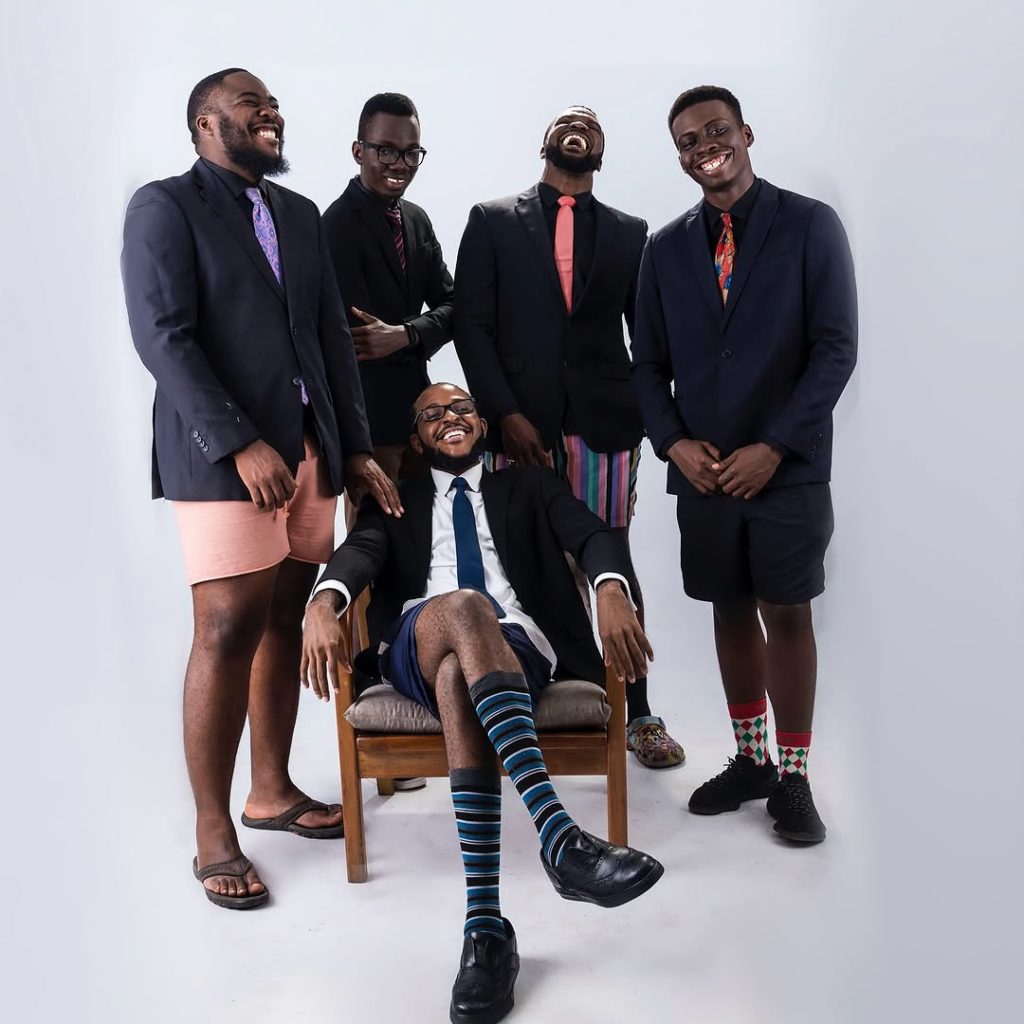
About a year ago, five stand-up comedians鈥�, , , , and 鈥攄ecided they wanted to create a show that would inform the public about the news while being entertaining and genuinely funny. It would blend acting, sketches, and fictional characters, leaning heavily into the conventions of American late-night talk shows like Last Week Tonight with John Oliver. However, rather than a direct imitation, their vision was closer to a Saturday Night Live-style performance鈥攅xcept not live. Not yet.
The show would be unapologetically Nigerian, tackling news with sharp humour while ensuring the facts remained intact.
Each of them took on specific roles: Eme reads the news, Fejiro anchors Amebo Corner, Kolamide handles the sports segment, Timi plays a fictional character called Dr. Arogundade, and Okiki and Fejiro co-host Corruption Forecast. They secured a sponsorship from Minimie, and they named it .
Over the years, Nigeria has seen stand-up comedy shows, sketch series, and even fictional characters delivering the news. But in at least a decade, none have been as ambitious as theirs. They want to revive the late-night talk show format they grew up watching鈥攐ne that moves away from tired caricatures of women and disabled people, shifting instead towards elevating discourse, provoking deep thought, and making Nigerians laugh while thinking critically.
In this week鈥檚 #MadeinNigeria, the cast talk about how they make the show, the future of Nigerian stand-up comedy, and the constant battle between facts and jokes.
This interview has been edited for clarity and length.
When did you begin to think of a show like this?
Kolamide: We are all comedians. We met at different points, but we all go to the same comedy clubs. The idea of doing something different had been floating around for a while. I had the idea years ago, and Eme had done something similar with a one-man show. It was really good, but it wasn鈥檛 sustainable to keep doing it by himself鈥攚riting, editing, and shooting. When I proposed the idea to him, he showed me what he had done, and we realized we needed more people on board. So, we spoke to Fejiro, Timi, and Okiki.
Timi and Fejiro came on but didn鈥檛 return the second time because there was no food.
Timi: That is not what happened.
Eme: When we started, we asked ourselves: What are we looking to achieve with this? Who is our target audience? What are we willing to say? How do we want to sound? We had a clear picture of what we wanted.
Why did you decide to come on board?
Okiki: I was really interested in this idea, and I hope to do something like this someday. When Kolamide told me they wanted to onboard me, I had to say I needed to think about it, because I didn鈥檛 want to act too excited. But what I love about the show is that we have conversations that people don鈥檛 have online. We can penetrate the internet and discuss important issues. Some political stories don鈥檛 trend on social media, but they have real legislative impact. We make people aware of things that don鈥檛 always make it to mainstream media.
ALSO READ: Emmanuella Samuel on Being a Child Star
What is the process of making an episode like?
Timi: Our process is simple. Everyone on the team reads the news, collects stories, and shares them in our group chat. We also have calls almost every day.
Sometimes, the news itself is the joke because Nigeria is a funny place. Other times, we have to think on it for a while. It depends on the story and the context. We bounce ideas off each other and try to consider as many angles as possible so there鈥檚 little to no bias. We refine the material and eventually turn it into a script. If a story lends itself to a sketch, we craft one.
Then, we align and shoot. The cast members double as actors in some of the sketches. We also have a secret ingredient鈥攂ut we won鈥檛 reveal that. Who does that?
It鈥檚 a lot of work, but it鈥檚 also very rewarding. As stand-up comedians, this is what we do.
Do you guys ever fight?
Fejiro: Eme and I are the ones who argue the most. Our biggest debate is always: 鈥淚s the news we鈥檙e reporting true? And is it funny?鈥� Sometimes, in an attempt to be funny, you might want to distort facts. But facts aren鈥檛 always funny. That鈥檚 where our disagreements happen. But it鈥檚 good. If we were always on the same page, I don鈥檛 think we would have made as much progress.
The fact that we can disagree makes for a better show. The audience doesn鈥檛 necessarily share the same views as we do. So, it鈥檚 best if we give balanced reportage鈥攚e鈥檙e not leaning left or right; we鈥檙e somewhere in the middle.
Eme: The news is inherently boring and dangerous in Nigeria. Because of how polarized the country is, you have to know how to navigate those murky waters. We try not to pick sides. We just report the facts and make jokes from them rather than injecting personal opinions. At the same time, we didn鈥檛 want to be afraid to make the jokes. Is it funny? Is it true? Those are our guiding questions.
At the end of the day, we just want to be funny. We are not trying to be messiahs here, saving the country.
Okiki: Sometimes, you might say something funny that isn鈥檛 factual, but people understand that it鈥檚 a joke. However, we still prioritize reporting the facts because of what we鈥檙e trying to achieve.
The Nigerian standup scene has evolved from what it used to be, which is largely just throwing jabs at already marginalized people, to elevating discourse. How does this affect how you think about the show?
Kolamide: We knew that if we were going to do this, it had to be as authentic as possible. Comedy is about perspective. I grew up watching Night of a Thousand Laughs, but for me, it was just entertainment. When I started thinking seriously about comedy, I was drawn to Def Comedy Jam, All-Star Comedy, and comedians like Kevin Hart. But the person who really changed my perspective was Trevor Noah. He was African, yet he was talking about serious things and making them funny. He could joke about a governor, but in a subtle way鈥攎aybe making fun of his looks rather than policies. There was also the fear of being labelled or targeted. But Trevor talked about ethnic groups in South Africa in an intellectual way, and that really inspired me.
I try not just to make people laugh but to give them something to think about.
In the past, Nigerian comedy was shaped by what was accessible at the time鈥攑astor jokes, soldier jokes, 鈥渆 get one man鈥� jokes. It worked then, but if we are still stuck in that cycle, we haven鈥檛 evolved. Comedy as an art is reactive. We don鈥檛 create anything new; we react to what has already happened.
Timi: For a comedian who wants to have a strong voice and be remembered for their work, you need to have profound takes on social issues. Doing this every week builds that creative muscle. It forces us to find humour in things that, on the surface, aren鈥檛 funny.
Shows like Night of a Thousand Laughs had their place, and audiences enjoyed them. Those comedians weren鈥檛 trying to be philosophers; they were just trying to get laughs. When you go to a platform like that, you want to make your mark, and yabbing a popular person can do that for you.
But stand-up comedy should transcend just being funny. We, as comedians, have the job of holding up a mirror to society, pointing out hypocrisy. There are a lot of issues people think about but don鈥檛 have the courage to say. Our job is to say those things, make people laugh at them, and also make them think.
Kolamide: Unfortunately, Nigeria has a copycat mentality. If something works, 17 people will do the same thing. Instead of asking, What are my strengths? we just follow trends. When I started, some people told me, “You dey speak English for your comedy? You never ready.”
But now, a new wave is coming. People are realizing that you can make comedy differently. It鈥檚 tough, but breaking new ground is better than being stuck in the past.
Eme: I will still make fun of Toke Makinwa if I have to, but I think it will just sound different.
Is this a hard show to make?
Eme: When the show is running, it’s tough because you have to keep up. It鈥檚 This Week Tonight, which means we have to know what鈥檚 happening all week before we shoot. If you miss a day, you have to catch up. But we enjoy it鈥攎y hairline is receding, but we enjoy it.
Where do you see the show in five years?
Fejiro: Kolamide, though鈥擨 don鈥檛 think he鈥檒l still be in Nigeria in the next five years.
Ultimately, we hope to be a focal point for discussing social and economic issues in Nigeria. In other countries, late-night hosts bridge the gap between the political class and the middle class. We hope to be that. If you want the news in a way that will entertain you, we want to be your go-to show.