On April 19, 2023, a Twitter user with the handle @cbngov_akin1 claimed that the poverty rate increased while Peter Obi was governor of Anambra state. The has garnered over 91,000 views as of the time of filing this report.
On Wait First, we divide claims into three categories. A valid claim is fresh banana. A misleading claim is cold zobo, while an outrightly false claim is burnt dodo.
So, how valid is this claim?
Some background
[Peter Obi / Africa Report]
Peter Obi, the Labour Party鈥檚 (LP) presidential candidate, had a staggered time in office as governor of Anambra state. In 2003, he contested for governor under the All Progressives Grand Alliance (APGA). Chris Ngige was declared the winner, but in a lengthy court battle, the victory was overturned at the Supreme Court. Obi was reinstated as the election winner and assumed office in March 2006.
Obi was impeached in November 2006 and reclaimed his mandate following another court ruling. He returned to office in February 2007. He was removed again after the 2007 election but was reinstated by the Supreme Court. Obi won reelection and served as a two-term governor from March 2006 to March 2014.
Obi鈥檚 performance as governor has come under intense scrutiny since he declared his intention to run for president, particularly as his campaign promises hinged on combatting poverty. The Independent National Electoral Commission (INEC) announced him third in the presidential election with 6,101,533 votes.
Poverty is more than just a number. It’s a complex issue that affects many aspects of a person’s life. shows that poverty rates are measured by income levels falling below the poverty line. But poverty is not a one-dimensional problem that can be summed up with a single indicator. The National Bureau of Statistics (NBS) is the go-to agency in Nigeria for collecting, analysing, and disseminating crucial statistical information that helps understand the socioeconomic realities of the country’s citizens.
Verification
Our partners FactCheck Elections, . Here鈥檚 what they found.
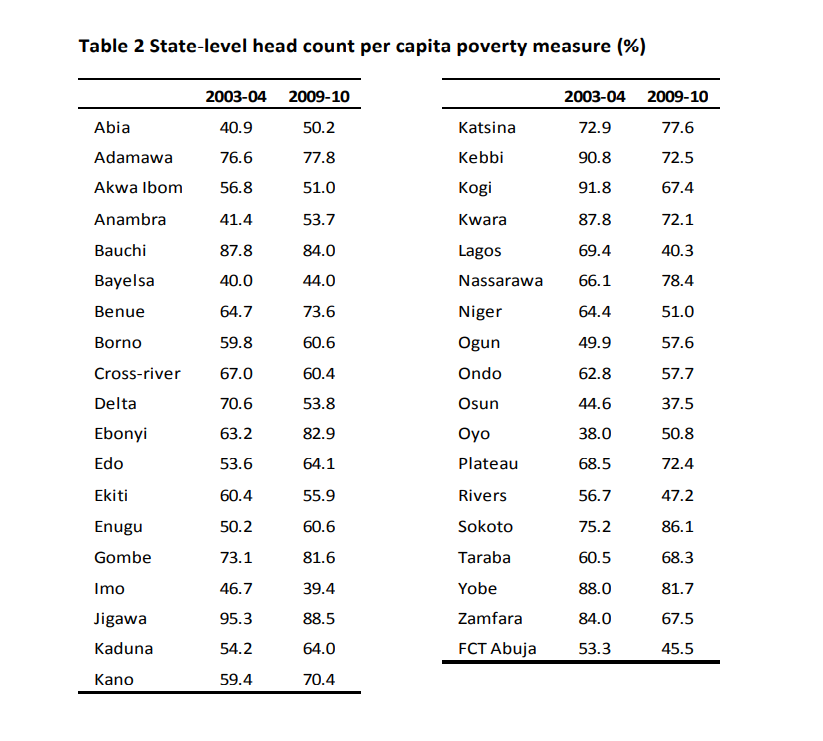
鈥淔indings by FactCheckElections revealed the National Poverty Rates For Nigeria: 2003-04 (Revised) and 2009-10 (Abridged Report). The report showed that Anambra had 41.4% state-level headcount per capita poverty measure in 2003-04 and 53.7% in 2009-10.聽
鈥淭he National Poverty Rates For Nigeria: 2003-04 (Revised) And 2009-10 (Abridged Report) capture poverty rates across Nigeria with the Absolute Poverty Approach (using a per capita approach of assigning 3000 calories requirement for an adult).
[Source: NBS]
鈥淔actcheckElection can find no official data report on the poverty rate between 2011 鈥� 2018. Aside from forecasts and predictions, there鈥檚 no absolute poverty study in those years. According to a reply by Dr Yemi Kale (former statistician general of Nigeria), 鈥楴BS has not conducted any absolute poverty study since 2009鈥�.
鈥淗owever,聽 there is a 2019 published by the NBS. The report showed Anambra had a poverty rate of 14.78%.鈥�
Verdict
So what鈥檚 the status of the claim? Based on data from the , Anambra鈥檚 state-level headcount per capita poverty increased from 41.4% in 2003-04 to 53.7% in 2009-10. Peter Obi was governor between 2006 and 2014. So the claim is partly true, and we give it a banana rating. However, no official data shows the poverty rate when he left office in 2014.